Chapter 4 — Rodeo (2024–2025)
An onchain social network where posts could be collected
By early 2024, it had become clear that the Foundation marketplace—despite its enormous success in 2021—was unlikely to become the enduring, scaled business we once imagined.
Digital art remained fragile, and the gallery ecosystem envisioned through Worlds was still years away from forming.
A deeper reinvention was required.
At the same time, the technical landscape was changing rapidly.
The Technical Inflection
Several infrastructure developments opened new possibilities for consumer products built on crypto rails.
These included:
- Layer 2 networks, which dramatically reduced gas costs
- Account abstraction, enabling smarter wallet infrastructure
- New social rails, particularly through protocols such as Farcaster
For the first time, it was possible to imagine building consumer applications where crypto infrastructure no longer created major usability barriers.
This created an opportunity for wholesale reinvention.
The Thesis
The core idea behind Rodeo was to explore micropayments as a new primitive for participation.
Instead of relying on high-priced auctions, we asked:
Could small, frequent transactions unlock new forms of demand?
The product took the form of a feed.
Posts themselves could become digital objects—owned, tracked, and transferable independently of any platform.
But unlike NFTs from the marketplace era, these posts were not intended to be scarce cultural artifacts. They were meant to be lightweight, expressive, and social.
This changed the economic equation.
In the NFT boom, capital had been the scarce resource.
On Rodeo, the scarce resource became presence and participation.
What We Built
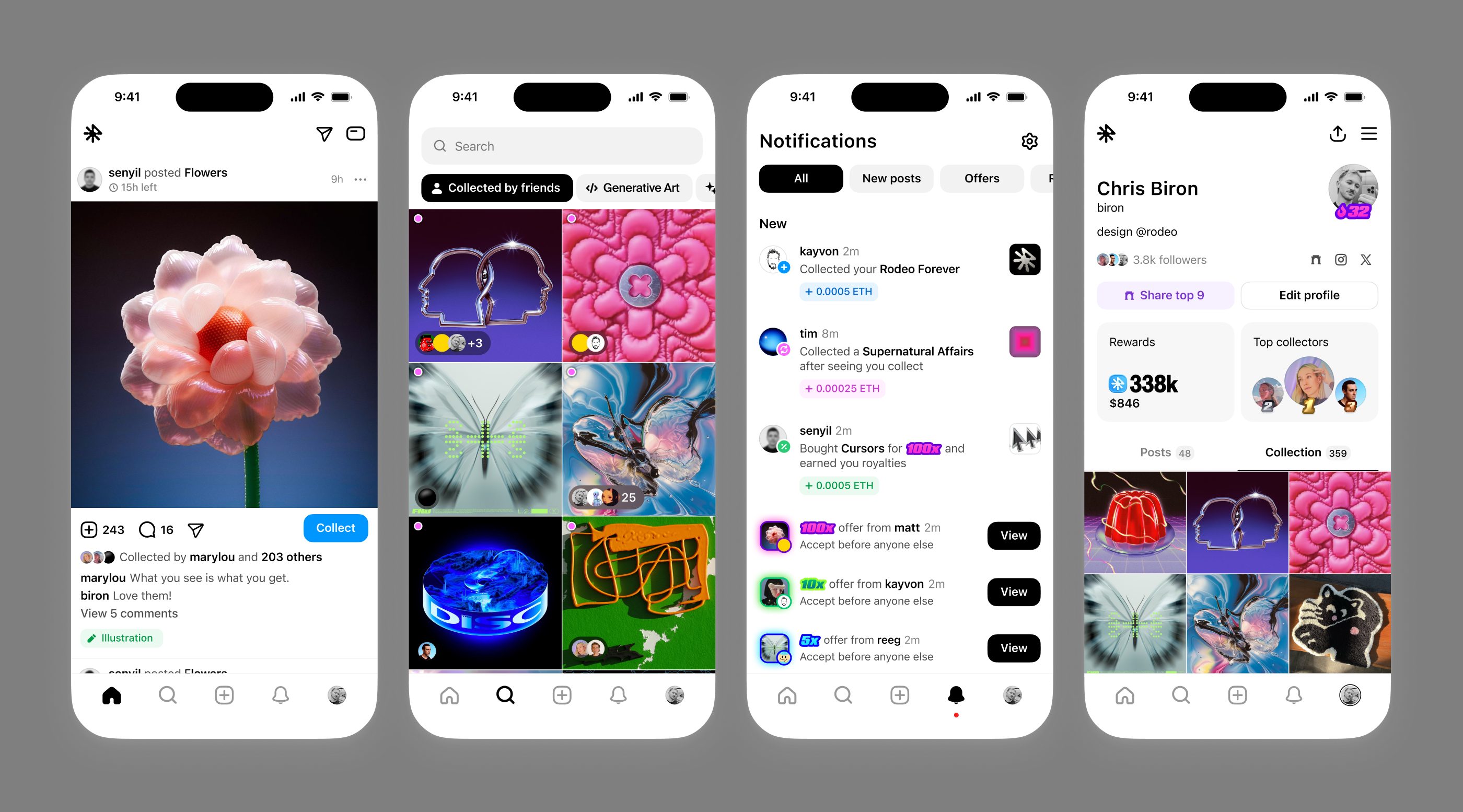
Rodeo was designed as a social network for creators and collectors.
Creators could:
- publish posts
- mint those posts as digital objects
- receive support through micropayments
Collectors could:
- discover posts in a feed
- collect posts they liked
- support creators directly through microtips
In return, collectors received an ownership stake in the post, allowing them to participate directly in the asset rather than simply donate.
The goal was to create an environment where creators could experiment freely and receive immediate feedback from their audience.
Pushing the Limits of UX
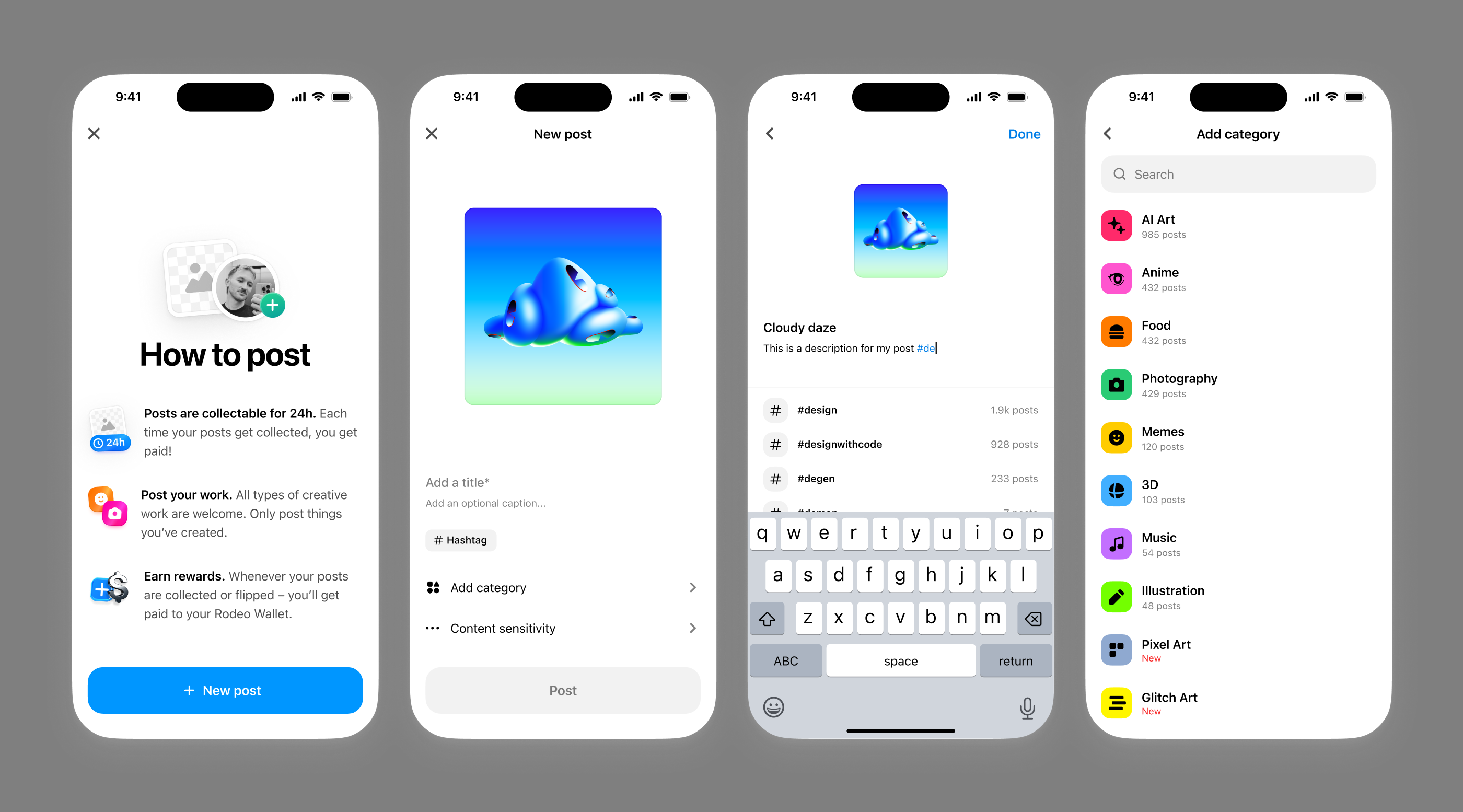
One of Rodeo’s core goals was accessibility.
We wanted users to participate without needing prior crypto knowledge.
To achieve this, the product pushed the limits of emerging infrastructure.
Key improvements included:
- gas sponsorship
- automatic smart account creation
- minimized signing interactions
- integrated onboarding and onramps
Users could join the platform and begin participating with almost no setup.
This represented one of the most seamless crypto onboarding experiences the company had built.
What Happened
Rodeo attracted a passionate user base that numbered in the thousands.
The community was deeply engaged and creative.
But the product did not reach a broader audience.
Two challenges became clear:
1. Mainstream Users Did Not Want to Collect Posts
The idea of collecting digital content still carried the cultural baggage of the NFT boom.
For many users, the concept felt speculative rather than expressive.
2. Micropayments Did Not Move the Needle
Microtips created a new mechanism for participation, but they did not translate into meaningful or sustained behavior.
For collectors, ownership stakes in posts were novel, but not compelling enough to drive repeated engagement.
For creators, the economics were limited without large audiences.
Costs accumulated without a clear reason for users to continue participating beyond patronage.
Without scale, the model remained limited.
The Deeper Constraint
Rodeo was built on the belief that improving infrastructure and reducing friction would unlock a broader audience.
We succeeded in making the product more accessible.
But we did not introduce a meaningfully new value proposition.
Instead, we repackaged a model that primarily appealed to users who were already interested in NFTs.
We continued to serve the same audience, but with different economics.
This was not sufficient to drive meaningful growth.
Improving how something works is not the same as changing why people care about it.
What We Learned
Several lessons became clear:
- lowering friction does not create demand
- micropayments require massive scale to matter
- social networks are driven by distribution, habit, and community
- even small monetary interactions introduce too much friction to serve as the foundation of a new social network
By mid-2025, it was increasingly clear that crypto and social were not natural partners—at least not in the form we had imagined.
The Transition
If collectible content was not the bridge to mainstream audiences…
Then the next question became unavoidable:
Which existing consumer behaviors could this technology enhance?
A clearer pattern was emerging.
Prediction markets.
That realization led to the final chapter:
Aura.